> For the complete documentation index, see [llms.txt](https://docs.candelacharts.com/llms.txt). Markdown versions of documentation pages are available by appending `.md` to page URLs; this page is available as [Markdown](https://docs.candelacharts.com/investing/macro-and-liquidity/global-m2/usage.md).
# Usage
Global M2 Usage
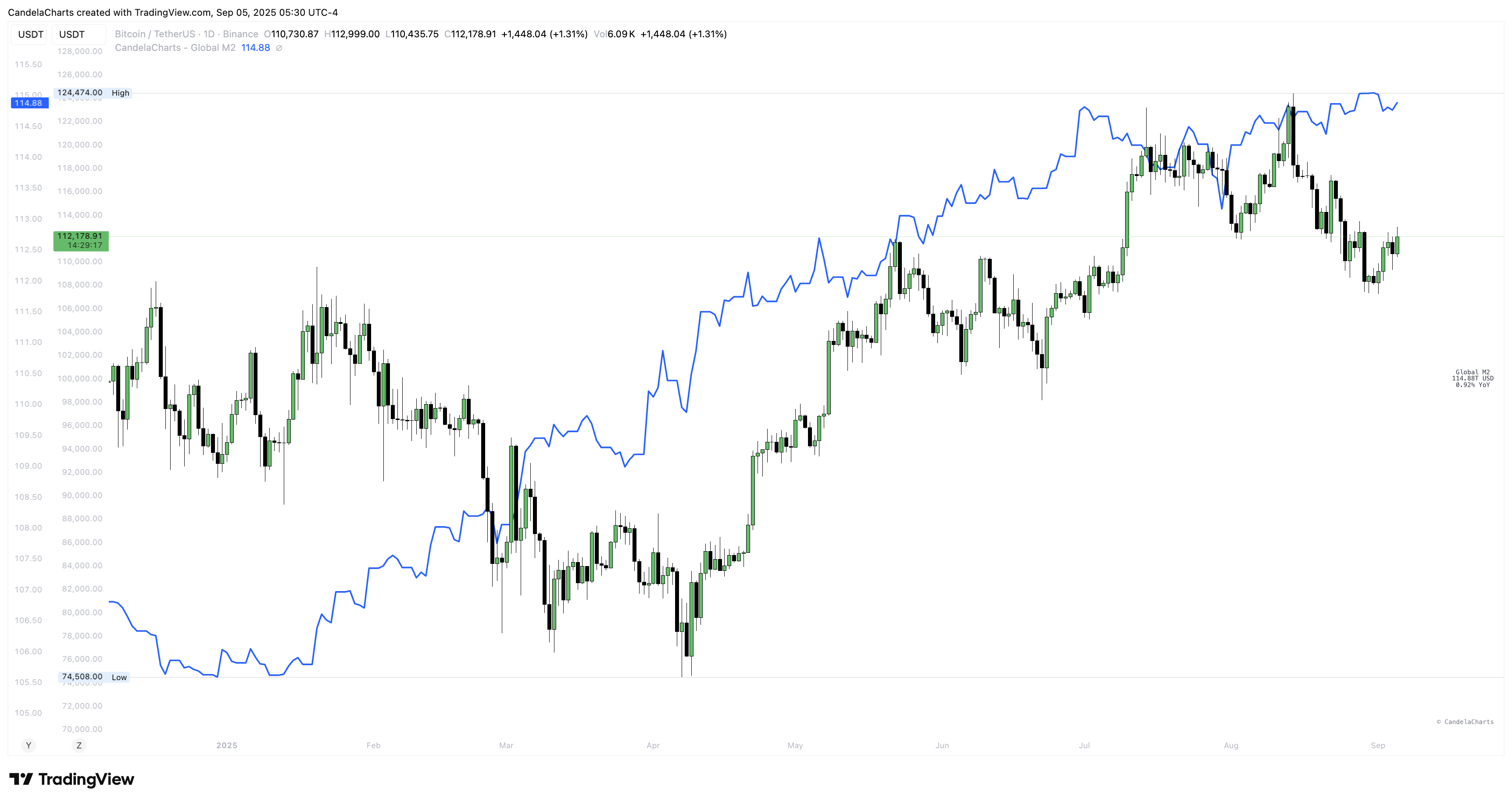
Turn the aggregate into decisions by reading the slope, the YoY impulse, and the relationship to the assets you trade.
* **Cycle context:** Rising Global M2 with positive/accelerating YoY often aligns with **risk-on**; flat/declining liquidity can precede **risk-off**.
* **Asset overlay:** Compare Global M2 vs. indices (S\&P 500, NASDAQ), crypto (BTC/ETH), or commodities (Gold/Oil) to spot support or divergences.
* **Lead–lag testing:** Use **Offset (± up to 52 weeks)** to examine whether liquidity changes precede or follow your target asset on your timeframe.
* **Regional attribution:** Toggle regions to isolate the influence of key blocs (US, China, Eurozone) on the aggregate.
* **Risk calibration:** Tighten risk when YoY compresses or flips negative; consider scaling exposure when YoY re-accelerates—always with price confirmation.
---
# Agent Instructions
This documentation is published with GitBook. GitBook is the documentation platform designed so that both humans and AI agents can read, navigate, and reason over technical content effectively. Learn more at gitbook.com.
## Querying This Documentation
If you need additional information that is not directly available in this page, you can query the documentation dynamically by asking a question.
Perform an HTTP GET request on the current page URL with the `ask` query parameter, and the optional `goal` query parameter:
```
GET https://docs.candelacharts.com/investing/macro-and-liquidity/global-m2/usage.md?ask=&goal=
```
`ask` is the immediate question: it should be specific, self-contained, and written in natural language.
`goal` is optional and describes the broader end goal you are ultimately trying to accomplish on behalf of the user. GitBook uses it to tailor the answer towards what is most useful for that goal.
The response will contain a direct answer to the question and relevant excerpts and sources from the documentation.
Use this mechanism when the answer is not explicitly present in the current page, you need clarification or additional context, or you want to retrieve related documentation sections.