> For the complete documentation index, see [llms.txt](https://docs.candelacharts.com/llms.txt). Markdown versions of documentation pages are available by appending `.md` to page URLs; this page is available as [Markdown](https://docs.candelacharts.com/investing/macro-and-liquidity/macro-sentiment-index/overview.md).
# Overview
Macro Sentiment Index Quick Specs
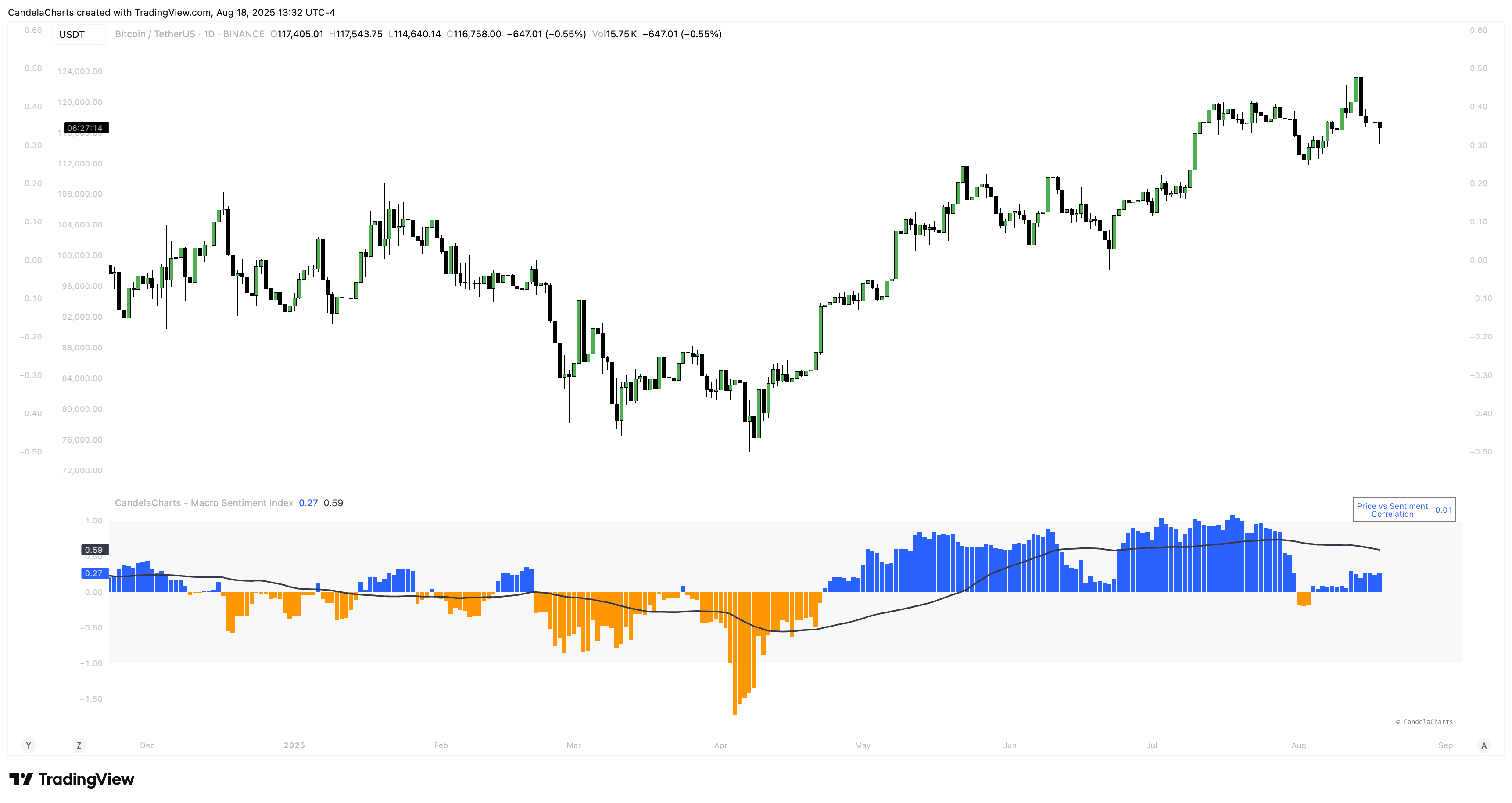
The **Macro Sentiment Index (MSI)** is a comprehensive, multi-asset indicator that synthesizes global financial market sentiment into a single, actionable metric. By aggregating and normalizing data from equities, bonds, commodities, currencies, volatility indices, and macroeconomic proxies, MSI provides traders and investors with a real-time pulse of risk appetite across markets.
The final composite score oscillates around zero:
* **Above 0**: Dominant risk-on sentiment
* **Below 0**: Growing risk aversion or defensive positioning
* **Beyond ±1**: Extreme regimes, often associated with market tops or stress events
A smoothing option (SMA, EMA, RMA, VWMA) allows users to filter noise, while visual modes (columns, histogram, area, line) enable flexible chart integration. The index also includes automatic correlation monitoring between price action and sentiment, helping identify divergences that may precede reversals.
{% content-ref url="/pages/tEVhuLsCeJeOrwnNECno" %}
[Features](https://docs.candelacharts.com/investing/macro-and-liquidity/macro-sentiment-index/features.md)
{% endcontent-ref %}
{% content-ref url="/pages/Z0wdbAFs2S8yc4159PkN" %}
[Usage](https://docs.candelacharts.com/investing/macro-and-liquidity/macro-sentiment-index/usage.md)
{% endcontent-ref %}
{% content-ref url="/pages/sCH7uy7V4XYhNqSSA1qR" %}
[Confluences](https://docs.candelacharts.com/investing/macro-and-liquidity/macro-sentiment-index/confluences.md)
{% endcontent-ref %}
{% content-ref url="/pages/s0IWNROMXgZliPWCyu4m" %}
[FAQs](https://docs.candelacharts.com/investing/macro-and-liquidity/macro-sentiment-index/faqs.md)
{% endcontent-ref %}
Designed for use across asset classes—including equities, forex, and crypto—MSI serves as a dynamic regime filter, trend confirmation tool, and early warning system for shifts in market psychology. Its modular input structure allows customization, empowering users to tailor sensitivity to current macro conditions.
---
# Agent Instructions
This documentation is published with GitBook. GitBook is the documentation platform designed so that both humans and AI agents can read, navigate, and reason over technical content effectively. Learn more at gitbook.com.
## Querying This Documentation
If you need additional information that is not directly available in this page, you can query the documentation by asking a question.
Perform an HTTP GET request on the following URL with the `ask` and `goal` query parameters:
```
GET https://docs.candelacharts.com/investing/macro-and-liquidity/macro-sentiment-index/overview.md?ask=&goal=
```
`ask` is the immediate question: it should be specific, self-contained, and written in natural language.
`goal` is what the user is ultimately trying to achieve, the reason they need the answer. Sharing it helps GitBook give you a better, more relevant answer. A goal is most helpful when it describes the outcome the user wants rather than restating the question. For example, with `ask=how do I create an API token`, a goal like `automate deployments from our CI pipeline` lets GitBook tailor the answer to that use case.
The response will contain a direct answer to the question and relevant excerpts and sources from the documentation.
Use this mechanism when the answer is not explicitly present in the current page, you need clarification or additional context, or you want to retrieve related documentation sections.