> For the complete documentation index, see [llms.txt](https://docs.candelacharts.com/llms.txt). Markdown versions of documentation pages are available by appending `.md` to page URLs; this page is available as [Markdown](https://docs.candelacharts.com/investing/market-structure-and-rotation/investor-tool/usage.md).
# Usage
Investor Tool Usage
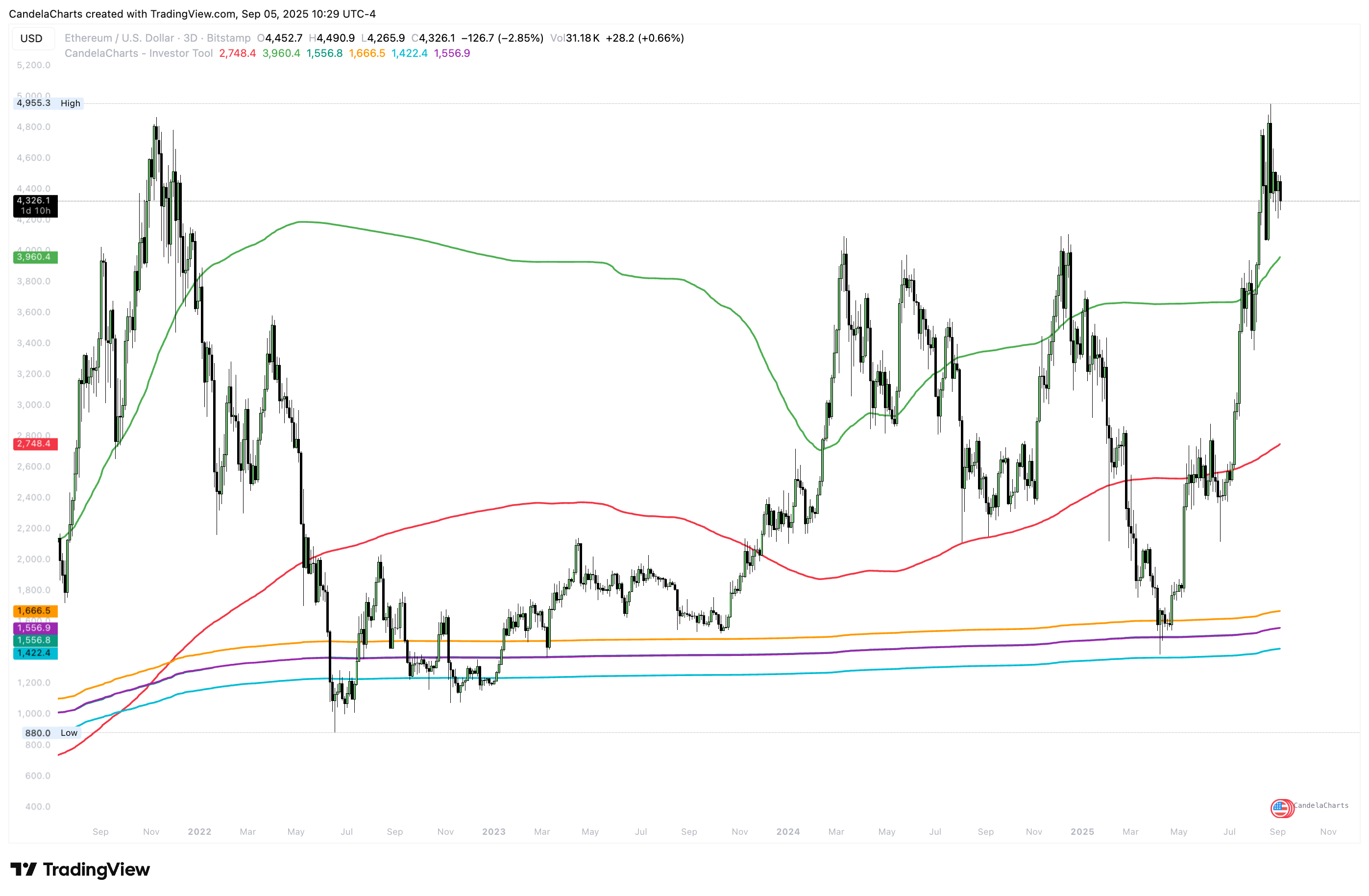
Turn drift into a plan by reading baseline slope, respecting dispersion, and letting anchors guide your execution.
**Playbook**
* **Regime by slope:** Rising MA → bias to accumulate on pullbacks; falling MA → favor patience, hedges, or trims.
* **Trade the stretch:**
* Near **Upper Band** → look for distribution, take partials, or require momentum confirmation to add.
* Near **Lower Band** (if enabled) → watch stabilization for staggered adds.
* **Anchor confluence:** Intersections of **Year WVAP** with **Quarter/Month WVAPs** often mark high-probability reaction zones.
* **Intraday awareness:** On intraday charts, “years” map to ≈252 bars/year; interpret the MA as a long sample of trading sessions.
* **Portfolio cadence:** Use MA slope + band touch + WVAP retest as a three-point checklist for scaling decisions.
**Parameter guidance**
* **MA Period (Years):** 2–3 for business cycle sensitivity; 5–10 to smooth secular noise.
* **Multiplier:** 1.2–1.8 for equities/indices; 1.6–2.4+ for crypto; 1.0–1.4 for low-vol defensives.
* **Anchors:**
* **Year:** Strategic fair-value magnet.
* **Quarter/Month:** Tactical pullbacks within the yearly path.
* **Week/Day:** Swing/active trading precision.
---
# Agent Instructions
This documentation is published with GitBook. GitBook is the documentation platform designed so that both humans and AI agents can read, navigate, and reason over technical content effectively. Learn more at gitbook.com.
## Querying This Documentation
If you need additional information that is not directly available in this page, you can query the documentation dynamically by asking a question.
Perform an HTTP GET request on the current page URL with the `ask` query parameter, and the optional `goal` query parameter:
```
GET https://docs.candelacharts.com/investing/market-structure-and-rotation/investor-tool/usage.md?ask=&goal=
```
`ask` is the immediate question: it should be specific, self-contained, and written in natural language.
`goal` is optional and describes the broader end goal you are ultimately trying to accomplish on behalf of the user. GitBook uses it to tailor the answer towards what is most useful for that goal.
The response will contain a direct answer to the question and relevant excerpts and sources from the documentation.
Use this mechanism when the answer is not explicitly present in the current page, you need clarification or additional context, or you want to retrieve related documentation sections.