> For the complete documentation index, see [llms.txt](https://docs.candelacharts.com/llms.txt). Markdown versions of documentation pages are available by appending `.md` to page URLs; this page is available as [Markdown](https://docs.candelacharts.com/investing/momentum-and-oscillators/vertex-oscillator/usage.md).
# Usage
Vertex Oscillator Usage
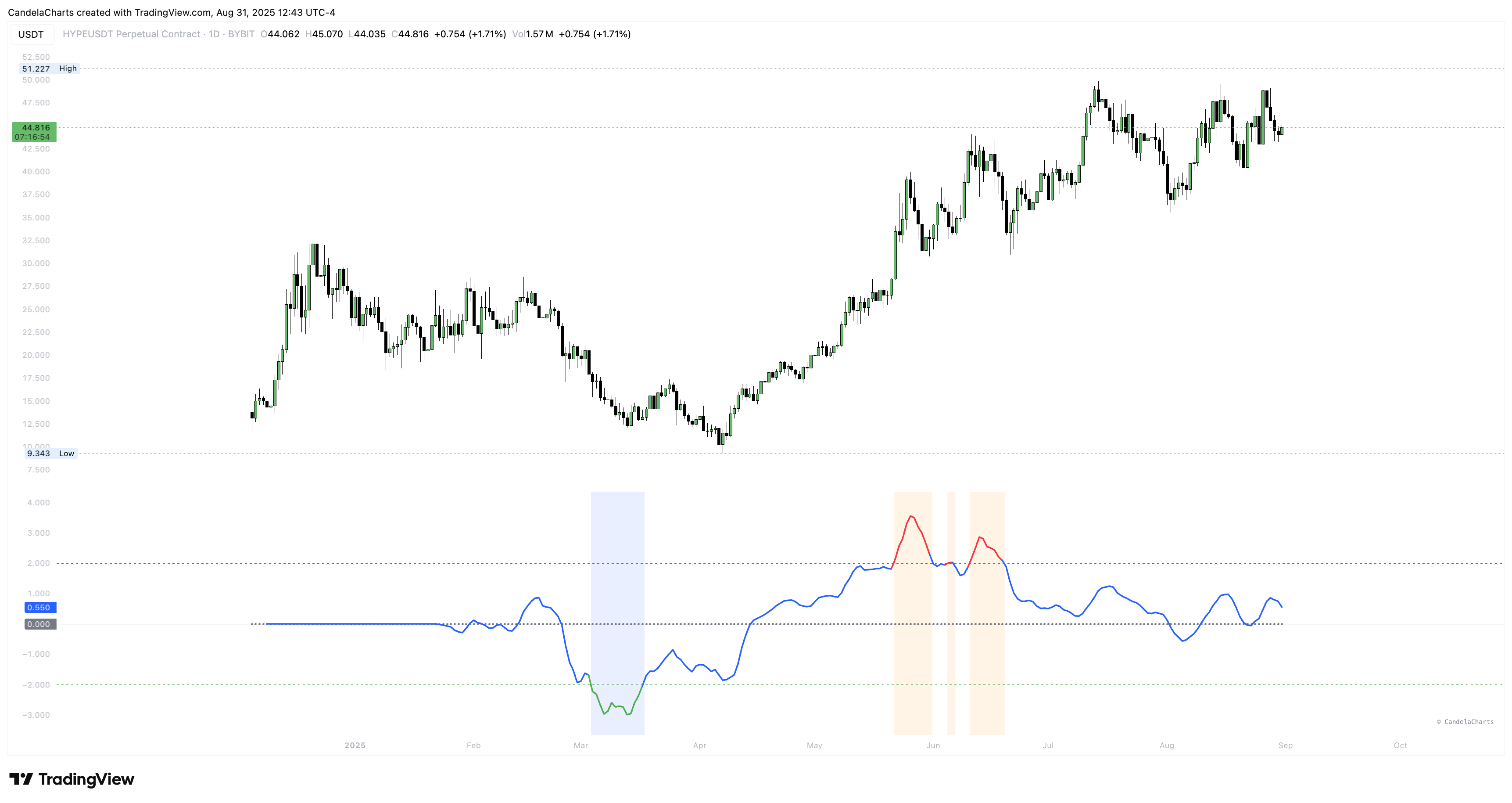
The Vertex Oscillator is designed to simplify market interpretation by highlighting extremes of undervaluation and euphoria. Traders can use its key levels and divergence signals to anticipate potential reversals, manage risk, and refine entries or exits.
* **Identify Accumulation** → When the oscillator drops below **-2**, it signals potential undervaluation or accumulation phases. These conditions can precede rebounds, especially when supported by rising volume or price stability.
* **Spot Euphoria** → When the oscillator rises above **+2**, it highlights overheated or euphoric conditions. This often aligns with profit-taking zones or potential pullbacks.
* **Neutral Zone** → Readings around **0** indicate balanced conditions where neither buyers nor sellers dominate. This zone is useful for avoiding overtrading during indecisive market phases.
* **Divergences** → Watch for **bullish divergence** (price making lower lows while the oscillator makes higher lows) or **bearish divergence** (price making higher highs while the oscillator makes lower highs). Divergences often signal weakening momentum and potential reversals.
* **Best Practice** → The Vertex Oscillator is most effective when combined with **trend analysis, support/resistance levels, or volume tools** to filter out noise and confirm signals.
---
# Agent Instructions
This documentation is published with GitBook. GitBook is the documentation platform designed so that both humans and AI agents can read, navigate, and reason over technical content effectively. Learn more at gitbook.com.
## Querying This Documentation
If you need additional information that is not directly available in this page, you can query the documentation dynamically by asking a question.
Perform an HTTP GET request on the current page URL with the `ask` query parameter, and the optional `goal` query parameter:
```
GET https://docs.candelacharts.com/investing/momentum-and-oscillators/vertex-oscillator/usage.md?ask=&goal=
```
`ask` is the immediate question: it should be specific, self-contained, and written in natural language.
`goal` is optional and describes the broader end goal you are ultimately trying to accomplish on behalf of the user. GitBook uses it to tailor the answer towards what is most useful for that goal.
The response will contain a direct answer to the question and relevant excerpts and sources from the documentation.
Use this mechanism when the answer is not explicitly present in the current page, you need clarification or additional context, or you want to retrieve related documentation sections.