> For the complete documentation index, see [llms.txt](https://docs.candelacharts.com/llms.txt). Markdown versions of documentation pages are available by appending `.md` to page URLs; this page is available as [Markdown](https://docs.candelacharts.com/investing/risk-adjusted-performance/omega-ratio/overview.md).
# Overview
Omega Ratio Quick Specs
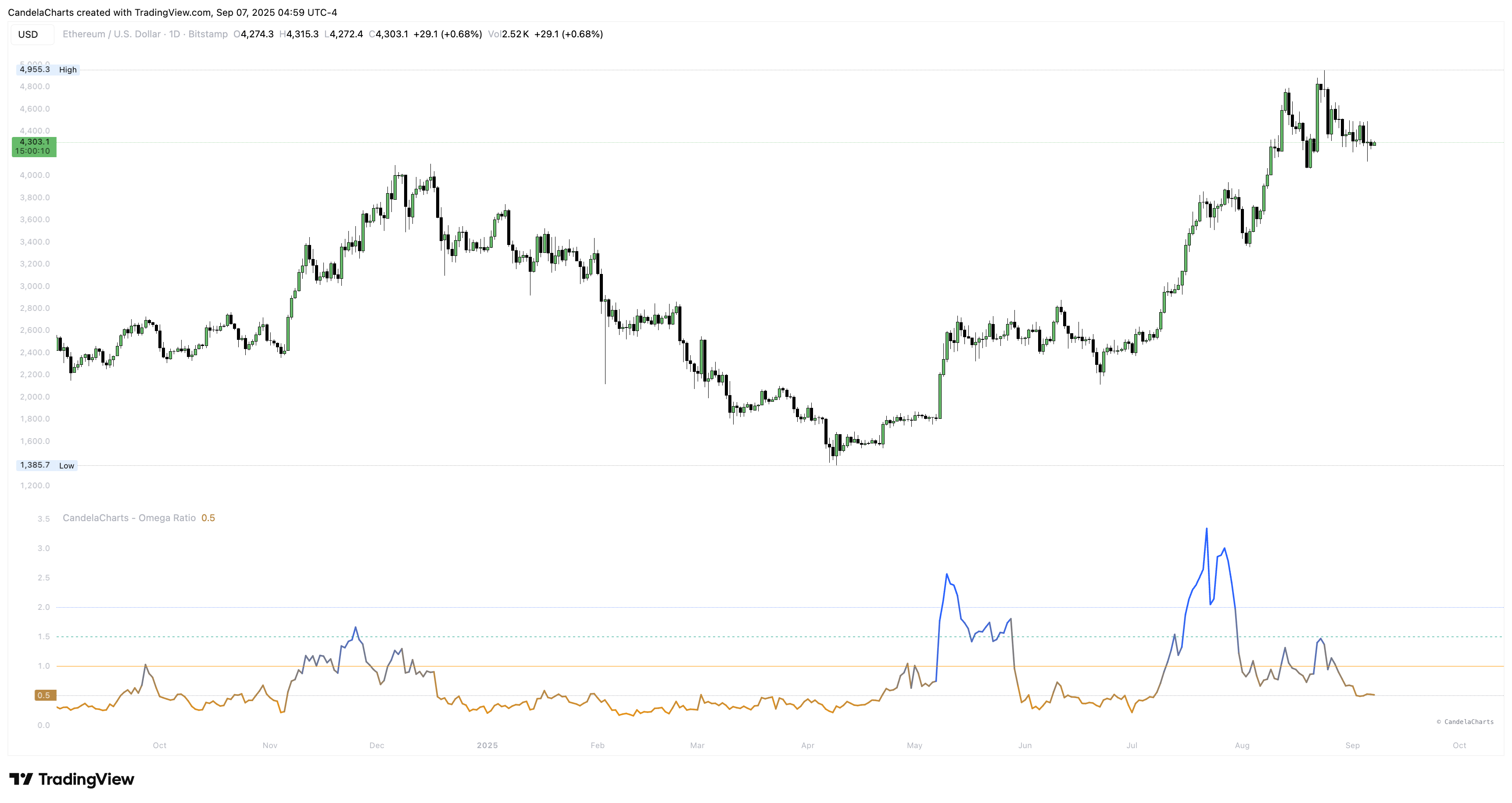
Think of **Omega** as a fairness check: how often—and by how much—your returns beat the bar you’ve set versus how often they fall short.
* **Set your hurdle:** You choose a **Target Return per bar** (e.g., 0.05% daily).
* **Tally each bar:** When a bar clears the hurdle, we count how much it beat it by (“excess gain”); when it misses, we count the shortfall.
* **Roll it up:** Over your chosen window, the indicator compares **total wins vs. total misses**.
* If wins outweigh misses, **Omega > 1** (quality is favorable).
* If misses dominate, **Omega < 1** (quality is weak).
* **Choose the lens:** Use **linear returns** for steady markets or **log returns** for larger, jumpy moves and cross-asset comparisons.
* **Read it at a glance:** A gradient line conveys intensity, reference levels at **0.5 / 1.0 / 1.5 / 2.0** frame poor→strong regimes, and built-in alerts ping on crosses of **1.0** to flag shifts in quality.
{% content-ref url="/pages/p5tAQRa5qM6AKmt8SXOX" %}
[Features](/investing/risk-adjusted-performance/omega-ratio/features.md)
{% endcontent-ref %}
{% content-ref url="/pages/2SUbpSvJ5UOjkESBzmWf" %}
[Usage](/investing/risk-adjusted-performance/omega-ratio/usage.md)
{% endcontent-ref %}
{% content-ref url="/pages/3HCalR2P2M2fGzmgagaV" %}
[Confluences](/investing/risk-adjusted-performance/omega-ratio/confluences.md)
{% endcontent-ref %}
{% content-ref url="/pages/kT2tPSrYOg5InjNMOg1p" %}
[FAQs](/investing/risk-adjusted-performance/omega-ratio/faqs.md)
{% endcontent-ref %}
Under the hood, the indicator turns your hurdle into a bar-by-bar test and scores how consistently price clears it.
---
# Agent Instructions
This documentation is published with GitBook. GitBook is the documentation platform designed so that both humans and AI agents can read, navigate, and reason over technical content effectively. Learn more at gitbook.com.
## Querying This Documentation
If you need additional information that is not directly available in this page, you can query the documentation dynamically by asking a question.
Perform an HTTP GET request on the current page URL with the `ask` query parameter, and the optional `goal` query parameter:
```
GET https://docs.candelacharts.com/investing/risk-adjusted-performance/omega-ratio/overview.md?ask=&goal=
```
`ask` is the immediate question: it should be specific, self-contained, and written in natural language.
`goal` is optional and describes the broader end goal you are ultimately trying to accomplish on behalf of the user. GitBook uses it to tailor the answer towards what is most useful for that goal.
The response will contain a direct answer to the question and relevant excerpts and sources from the documentation.
Use this mechanism when the answer is not explicitly present in the current page, you need clarification or additional context, or you want to retrieve related documentation sections.