> For the complete documentation index, see [llms.txt](https://docs.candelacharts.com/llms.txt). Markdown versions of documentation pages are available by appending `.md` to page URLs; this page is available as [Markdown](https://docs.candelacharts.com/investing/risk-and-portfolio-management/dip-index/overview.md).
# Overview
Dip Index Quick Specs
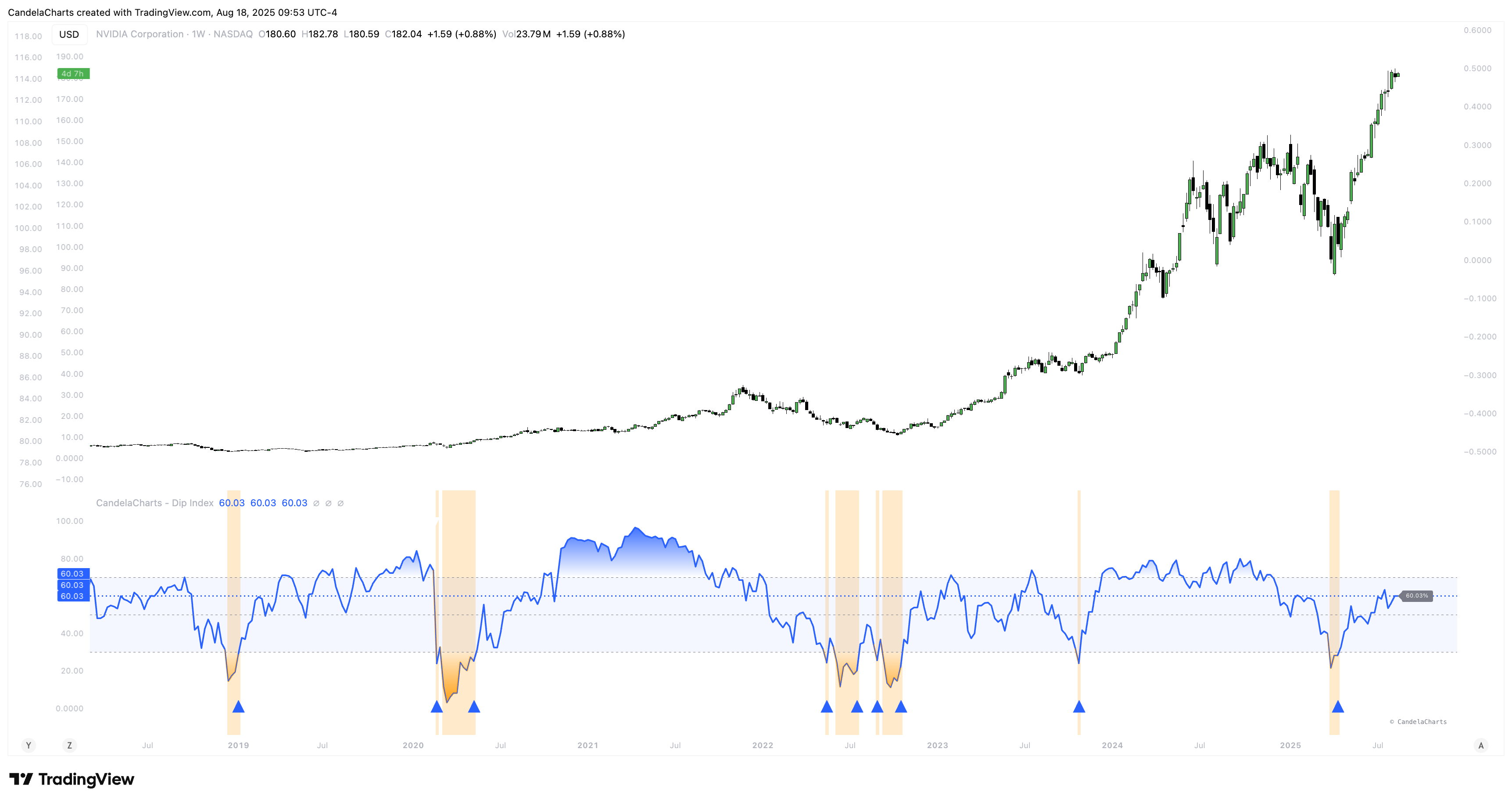
The **Dip Index (DIPX)** is a market breadth oscillator that measures the percentage of assets within a selected index trading above a specified moving average, such as the 50, 100, 150, or 200-day average.
{% content-ref url="/pages/ZprP5yC0gCuZ7CBnC8tz" %}
[Features](/investing/risk-and-portfolio-management/dip-index/features.md)
{% endcontent-ref %}
{% content-ref url="/pages/STMheeOAAoGB118GuPzq" %}
[Usage](/investing/risk-and-portfolio-management/dip-index/usage.md)
{% endcontent-ref %}
{% content-ref url="/pages/B74x65OwFBliSuTr0ge2" %}
[Confluences](/investing/risk-and-portfolio-management/dip-index/confluences.md)
{% endcontent-ref %}
{% content-ref url="/pages/NhJeo8mRsSPhNepsXVk4" %}
[FAQs](/investing/risk-and-portfolio-management/dip-index/faqs.md)
{% endcontent-ref %}
By evaluating the breadth of movement across constituents, the Dip Index provides a deeper understanding of underlying strength or weakness beyond the headline price.
---
# Agent Instructions
This documentation is published with GitBook. GitBook is the documentation platform designed so that both humans and AI agents can read, navigate, and reason over technical content effectively. Learn more at gitbook.com.
## Querying This Documentation
If you need additional information that is not directly available in this page, you can query the documentation dynamically by asking a question.
Perform an HTTP GET request on the current page URL with the `ask` query parameter, and the optional `goal` query parameter:
```
GET https://docs.candelacharts.com/investing/risk-and-portfolio-management/dip-index/overview.md?ask=&goal=
```
`ask` is the immediate question: it should be specific, self-contained, and written in natural language.
`goal` is optional and describes the broader end goal you are ultimately trying to accomplish on behalf of the user. GitBook uses it to tailor the answer towards what is most useful for that goal.
The response will contain a direct answer to the question and relevant excerpts and sources from the documentation.
Use this mechanism when the answer is not explicitly present in the current page, you need clarification or additional context, or you want to retrieve related documentation sections.