# Time Filter

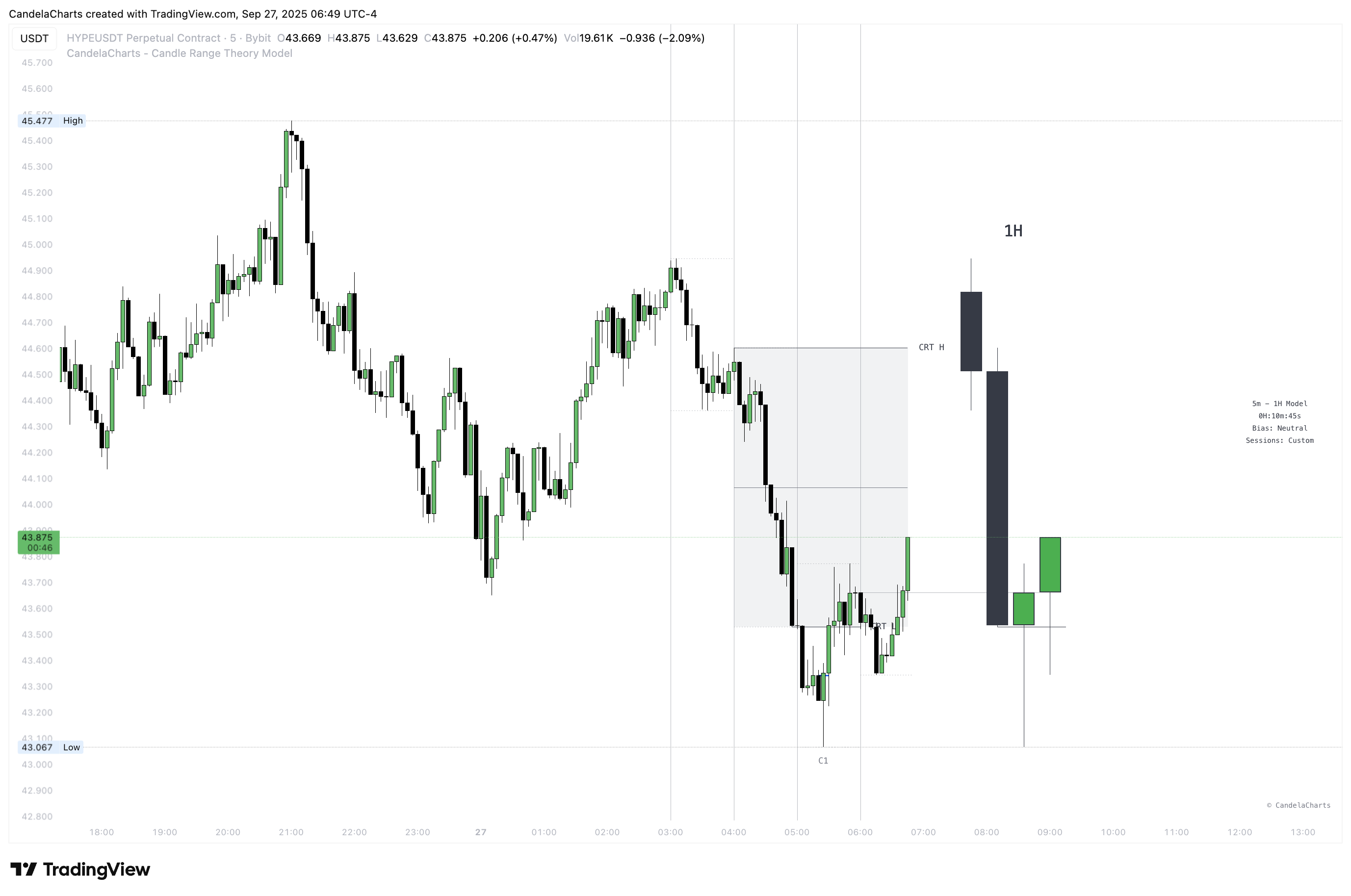
The Candle Range Theory (CRT) Model incorporates various times when the CRT can occur, each designed to analyze market trends at different levels of granularity.

<figure><img src="/files/AaXT6VTBBoStSAdEjn5O" alt=""><figcaption></figcaption></figure>

These specific times enable traders and investors to capture key price movements and shifts in market dynamics, offering insights across both short-term and long-term perspectives.

The CRT model supports the following times when the CRT can happen:

### 4-Hour CRT

<table><thead><tr><th width="163.7265625"></th><th></th></tr></thead><tbody><tr><td>1-5-9 (AM/PM)</td><td>Captures early market trends setting the tone for the trading day.</td></tr><tr><td>2-6-10 (AM/PM)</td><td>Analyzes market shifts after the early session and pre-midday changes.</td></tr></tbody></table>

### 1-Hour CRT

<table><thead><tr><th width="163.234375"></th><th></th></tr></thead><tbody><tr><td>8-9-10 (AM/PM)</td><td>Reflects late-market movements, influenced by global markets' closing.</td></tr><tr><td>2-3-4 (AM/PM)</td><td>Focuses on overnight consolidation and early morning trend shifts.</td></tr><tr><td>7-8-9 (AM/PM)</td><td>Tracks early morning market activity before the official opening.</td></tr></tbody></table>

By using these pairings, the CRT provides a comprehensive framework for market analysis across multiple timeframes, enabling users to adapt their approach based on specific trading objectives.


---

# Agent Instructions: Querying This Documentation

If you need additional information that is not directly available in this page, you can query the documentation dynamically by asking a question.

Perform an HTTP GET request on the current page URL with the `ask` query parameter:

```
GET https://docs.candelacharts.com/models/crt-model-tm/time-filter.md?ask=<question>
```

The question should be specific, self-contained, and written in natural language.
The response will contain a direct answer to the question and relevant excerpts and sources from the documentation.

Use this mechanism when the answer is not explicitly present in the current page, you need clarification or additional context, or you want to retrieve related documentation sections.
