> For the complete documentation index, see [llms.txt](https://docs.candelacharts.com/llms.txt). Markdown versions of documentation pages are available by appending `.md` to page URLs; this page is available as [Markdown](https://docs.candelacharts.com/models/unicorn-model-tm/standard-deviation.md).
# Standard Deviation
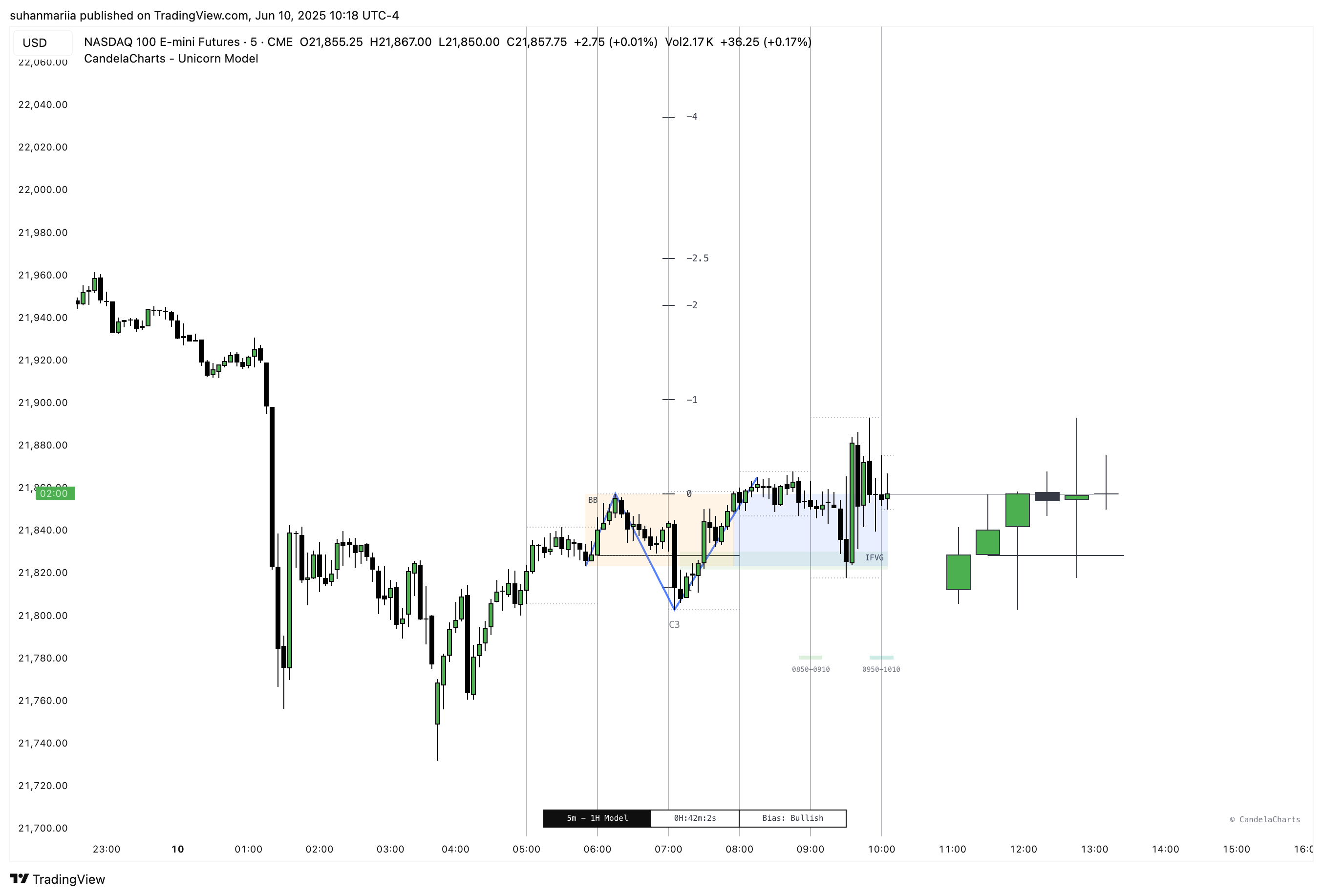
Unicorn Model Standard Deviation
Once a model is formed, the Unicorn Model calculates standard deviation levels based exclusively on the wicks of the MSS High and MSS Low, using the range between the Zigzag 2nd Point (anchor) and the Zigzag 3rd Point (manipulation swing) as the projection base.
These standard deviations measure the expected extension of price by quantifying its dispersion from this key structural move, helping forecast potential swing targets and overextensions. By anchoring the calculation to the wicks, the model captures the full breadth of price fluctuations, including volatility extremes and broader market dynamics.
Standard deviation levels such as 1σ and 2σ are extended from this base to anticipate price expansion zones. When price reaches or exceeds the 2σ level, the standard deviation is considered invalidated—signaling the move may be overextended or complete.
This wick-based, structural approach gives traders a comprehensive framework for planning exits, managing risk, and evaluating trend strength. These standard deviations are fundamental to the Unicorn Model, providing clear insights into future price behavior and enabling confident strategy execution.
---
# Agent Instructions
This documentation is published with GitBook. GitBook is the documentation platform designed so that both humans and AI agents can read, navigate, and reason over technical content effectively. Learn more at gitbook.com.
## Querying This Documentation
If you need additional information that is not directly available in this page, you can query the documentation dynamically by asking a question.
Perform an HTTP GET request on the current page URL with the `ask` query parameter, and the optional `goal` query parameter:
```
GET https://docs.candelacharts.com/models/unicorn-model-tm/standard-deviation.md?ask=&goal=
```
`ask` is the immediate question: it should be specific, self-contained, and written in natural language.
`goal` is optional and describes the broader end goal you are ultimately trying to accomplish on behalf of the user. GitBook uses it to tailor the answer towards what is most useful for that goal.
The response will contain a direct answer to the question and relevant excerpts and sources from the documentation.
Use this mechanism when the answer is not explicitly present in the current page, you need clarification or additional context, or you want to retrieve related documentation sections.