> For the complete documentation index, see [llms.txt](https://docs.candelacharts.com/llms.txt). Markdown versions of documentation pages are available by appending `.md` to page URLs; this page is available as [Markdown](https://docs.candelacharts.com/models/x-model-tm/components.md).
# Components
X Model Components
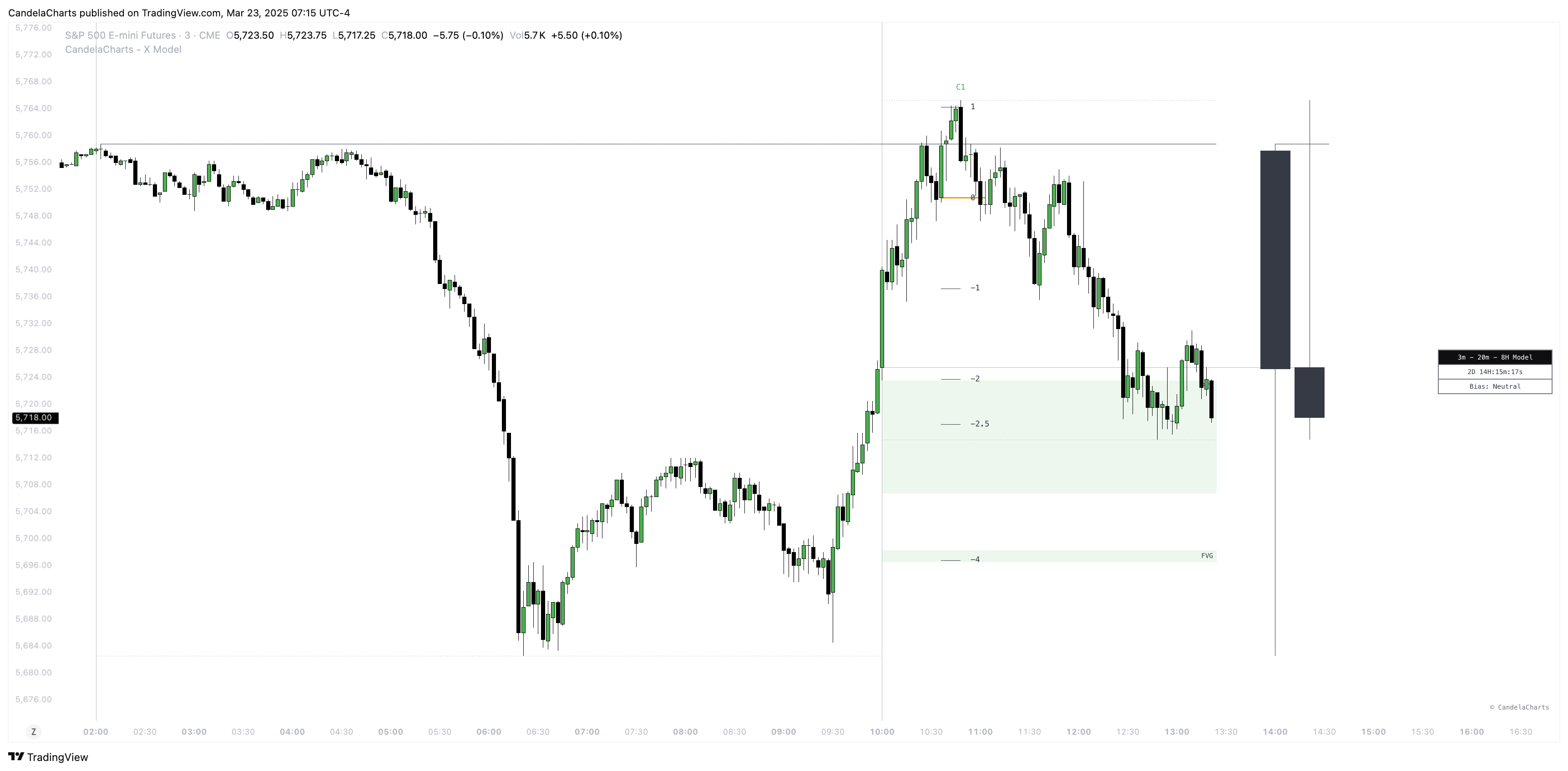
The **X Model** in trading is a methodical approach that combines key market behaviors to identify promising trading opportunities.
The following key components form the foundation of the X Model. Each element plays a critical role in how the model analyzes market structure, identifies trading opportunities, and guides strategic decision-making. Understanding these components is essential for effectively applying the model in real-world trading scenarios.
## Key Components
### **1D-Previous High/Low Run (ERL)**
Determines if the previous day's high or low has been broken, signaling potential shifts in market direction.
### **1H-Fair Value Gap (IRL)**
Focuses on finding an optimal entry point by targeting the 1-hour Fair Value Gap, especially around the 50% level of the previous day's price range.
### **15m-Smart Money Technique (SMT)**
Utilizes SMT indicators to verify the market structure shift, ensuring alignment with institutional trading patterns.
### **15m-Change In State Of Delivery (CISD)**
Examines changes in market structure on a 15-minute chart to confirm the trend direction established by the previous day's high/low breakout.
{% hint style="info" %}
The traditional model identifies Market Structure Shifts (MSS) based on candle wicks, while the Change In State of Delivery (CISD) approach focuses on candle bodies—an approach utilized in our model’s algorithm.
{% endhint %}
---
# Agent Instructions
This documentation is published with GitBook. GitBook is the documentation platform designed so that both humans and AI agents can read, navigate, and reason over technical content effectively. Learn more at gitbook.com.
## Querying This Documentation
If you need additional information that is not directly available in this page, you can query the documentation dynamically by asking a question.
Perform an HTTP GET request on the current page URL with the `ask` query parameter, and the optional `goal` query parameter:
```
GET https://docs.candelacharts.com/models/x-model-tm/components.md?ask=&goal=
```
`ask` is the immediate question: it should be specific, self-contained, and written in natural language.
`goal` is optional and describes the broader end goal you are ultimately trying to accomplish on behalf of the user. GitBook uses it to tailor the answer towards what is most useful for that goal.
The response will contain a direct answer to the question and relevant excerpts and sources from the documentation.
Use this mechanism when the answer is not explicitly present in the current page, you need clarification or additional context, or you want to retrieve related documentation sections.