> For the complete documentation index, see [llms.txt](https://docs.candelacharts.com/llms.txt). Markdown versions of documentation pages are available by appending `.md` to page URLs; this page is available as [Markdown](https://docs.candelacharts.com/models/sfp-model.md).
# SFP Model™
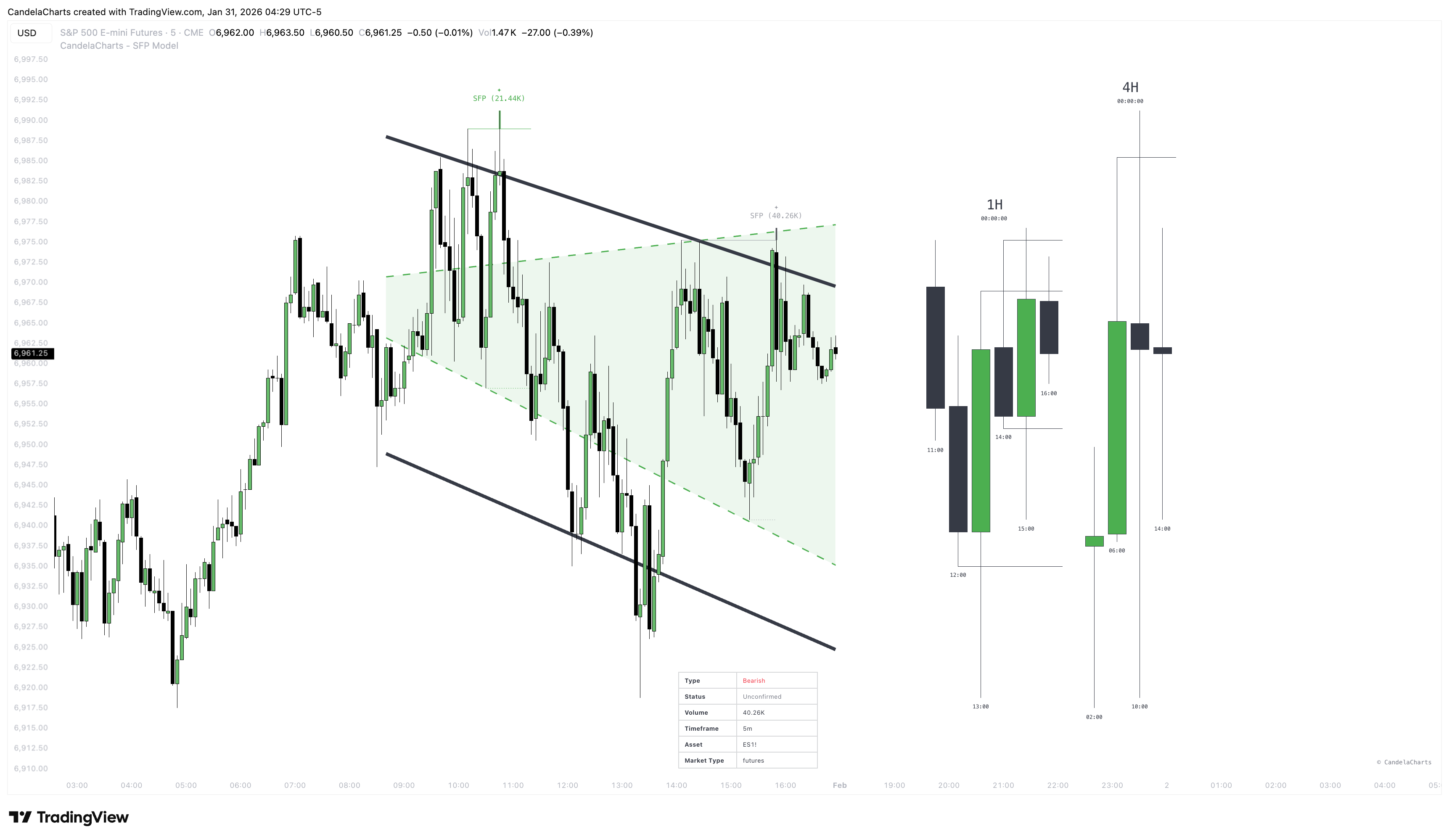
**CandelaCharts – SFP Model** is an advanced indicator designed to detect and visualize **Swing Failure Patterns (SFP)** — also known as liquidity grabs, fakeouts or Turtle Soup setups.
It combines:
* precise SFP pattern recognition
* higher timeframe (HTF) candle rendering with liquidity sweep visualization
* dynamic trendlines and regression-based channels
* multi-timeframe success/failure tracking
* optional high-probability filtering using channel or trendline interaction
* lower timeframe imbalances like fvg and ifvg
* automatic multi-length pivot scanning mode
* rich status-aware labeling and a configurable information dashboard
The main purpose is to help traders clearly see high-probability reversal zones created by liquidity sweeps, while providing strong contextual information through higher timeframe structure, dynamic boundaries, and model performance feedback.
{% hint style="warning" %}
* This model is designed for educational and analytical purposes to study market structure, trends, and price behavior.
* It does not provide trading signals and should not be used as a substitute for independent analysis or proper risk management.
* The model is timeframe - and symbol-agnostic, automatically adapting to any market, asset, or chart it is applied to.
{% endhint %}
---
# Agent Instructions
This documentation is published with GitBook. GitBook is the documentation platform designed so that both humans and AI agents can read, navigate, and reason over technical content effectively. Learn more at gitbook.com.
## Querying This Documentation
If you need additional information that is not directly available in this page, you can query the documentation by asking a question.
Perform an HTTP GET request on the following URL with the `ask` and `goal` query parameters:
```
GET https://docs.candelacharts.com/models/sfp-model.md?ask=&goal=
```
`ask` is the immediate question: it should be specific, self-contained, and written in natural language.
`goal` is what the user is ultimately trying to achieve, the reason they need the answer. Sharing it helps GitBook give you a better, more relevant answer. A goal is most helpful when it describes the outcome the user wants rather than restating the question. For example, with `ask=how do I create an API token`, a goal like `automate deployments from our CI pipeline` lets GitBook tailor the answer to that use case.
The response will contain a direct answer to the question and relevant excerpts and sources from the documentation.
Use this mechanism when the answer is not explicitly present in the current page, you need clarification or additional context, or you want to retrieve related documentation sections.